🚨 BREAKING NEWS: TOM BRADY’S ALLEGED MID-FLIGHT GESTURE TO AN ELDERLY VETERAN IS MOVING FOOTBALL FANS — BUT DID THE NFL LEGEND REALLY GIVE UP HIS PREMIUM SEAT IN SECRET? ❤️🏈🇺🇸
Tom Brady spent more than two decades performing in front of millions of people.
Super Bowls.
Championship parades.
Packed stadiums.
National television broadcasts.
Almost every major moment of his football career unfolded with cameras watching.
But according to an emotional story now circulating online, one of Brady’s most memorable gestures supposedly happened somewhere completely different:
Aboard an ordinary flight, only minutes before departure.
The narrative claims Brady was seated in a premium cabin when he noticed an elderly military veteran nearby. Rather than remain in his more comfortable seat, Brady supposedly approached the veteran and quietly offered to exchange places.
No announcement.
No speech.
No request for photographs.
According to the story, Brady simply gave the veteran his premium seat and moved elsewhere on the aircraft.
Other passengers allegedly realized what had happened only afterward.
It is exactly the kind of story that can spread rapidly because its message is so simple:
One of football’s most famous athletes choosing respect over privilege.
But there is an important distinction between an inspiring story and an authenticated one.
Without an identifiable passenger account, airline confirmation, photograph, video or direct statement from Brady, the precise details of the alleged exchange should not automatically be treated as established fact.


The story resonates particularly strongly because Brady’s connection with New England remains enormous.
He arrived as the 199th overall selection in the 2000 NFL Draft, hardly carrying the profile of a future superstar.
What followed became one of the defining careers in American professional sports.
Brady helped the New England Patriots win six Super Bowls.
He became the central figure in a dynasty that transformed expectations around the franchise.
Later, after leaving New England, he won another championship with the Tampa Bay Buccaneers.
Seven Super Bowl titles.
Five Super Bowl MVP awards.
Multiple NFL MVP honors.
Decades of unforgettable postseason performances.
By the time Brady retired, his public identity had become inseparable from winning.
Yet stories such as the alleged airplane encounter appeal to fans for a completely different reason.
There is no touchdown involved.
No championship ring.
No fourth-quarter comeback.
Instead, the story asks what someone with extraordinary status does when there is seemingly nothing to gain.
That is where the veteran becomes central to the narrative.
The image is powerful.
An elderly person who once served his country preparing for an ordinary flight.
A globally recognizable athlete sitting nearby.
Then an unexpected offer.
Take my seat.
If verified, the gesture would not require a long explanation.


There is also a reason the claim that Brady “didn’t want attention” makes the story especially compelling.
Modern celebrity life is heavily documented.
Athletes have social-media teams.
Charitable appearances generate photographs.
Brands create campaigns around inspirational stories.
That does not make public charitable work meaningless — visibility can help important causes reach far larger audiences.
But private generosity carries a different emotional quality.
If nobody is supposed to know, people naturally perceive the gesture as more personal.
That is precisely why this detail also deserves scrutiny.
If Brady deliberately avoided publicity and nobody was documenting the encounter, how did the exact story become public?
Who witnessed the exchange?
Did that person speak publicly?
Was the veteran identified?
Was the airline involved?
Was there a photograph?
Did Brady or one of his representatives acknowledge the encounter?
Those questions are not meant to dismiss the story.
They are the questions that separate an inspiring anecdote from a verified event.
Viral celebrity stories frequently follow a familiar structure.
A famous person notices someone struggling.
The celebrity quietly intervenes.
Nobody recognizes what happened initially.
A witness eventually understands the celebrity’s identity.
The celebrity refuses praise.
Then the story spreads worldwide.
Sometimes those stories are completely genuine.
Sometimes a real interaction becomes exaggerated.
And sometimes a fictional story is repeatedly reposted until the number of repetitions makes it appear authentic.
That is why provenance matters.


The military element also carries particular emotional significance around the NFL.
Professional football has long incorporated military recognition into games and league events.
Veterans and active-duty service members regularly participate in ceremonies.
Teams host military families.
Players take part in community programs.
For supporters, seeing an athlete recognize an elderly veteran therefore fits a familiar tradition of respect.
But the veteran in this specific story should not be turned into a fictional character.
Without verified information, there is no reason to invent his name.
No reason to invent which branch of the military he served in.
No reason to claim he fought in Vietnam, Korea or another conflict.
No reason to create a dramatic conversation between him and Brady.
And no reason to manufacture tears, salutes or applause from the cabin.
The alleged seat exchange is already powerful enough.
Adding unsupported details would only weaken it.
There is another interesting dimension.
A premium airline seat represents comfort, but for someone with Brady’s wealth and status, giving it away would probably involve relatively little material sacrifice.
That does not make the gesture meaningless.
The significance would come from noticing another person.
An elderly traveler may benefit considerably more from additional space and comfort during a flight.
Recognition matters too.
Brady would be communicating that the veteran’s service deserved acknowledgment.
That is why simple acts can resonate.
They do not have to be enormous to be meaningful.
Sports fans spend years watching athletes under carefully controlled conditions.
Helmets.
Uniforms.
Press conferences.
Commercials.
Highlight packages.
Occasionally, stories emerge that supposedly show what those athletes are like when the formal setting disappears.
People are naturally fascinated by those moments because character is difficult to measure.
There is no statistic for kindness.
No quarterback rating for generosity.
No championship trophy for giving somebody else your seat.
That makes stories about private gestures unusually attractive.
But it also makes them easy to fabricate.
A positive story can spread just as rapidly as a negative rumor.
And because people want an uplifting story to be true, they may be less likely to question it.
Brady does not need a fictional airplane encounter to establish his legacy.
His football accomplishments are already documented.
His charitable and community activities can be evaluated through publicly established actions.
If this particular encounter is eventually supported by an identifiable firsthand account or other reliable evidence, it can become another genuine chapter in the public understanding of Brady.
Until then, the appropriate distinction is simple.
The story is inspiring.
Its precise details are not yet established here.
And perhaps there is a broader lesson in why millions of sports fans are attracted to stories like this in the first place.
People admire championships.
They admire greatness.
They admire records that may survive for generations.
But they also want their heroes to recognize people who will never appear on a scoreboard.
The veteran.
The stadium worker.
The child in the hospital.
The stranger sitting several rows away.
Football made Tom Brady famous.
An alleged gesture like this attracts attention because, for one quiet moment, fame supposedly became irrelevant.
There was simply one passenger recognizing another.
If that is indeed what happened, the most meaningful part of the story may be precisely what the headline claims Brady never wanted:
Attention.
Because sometimes the strongest gesture is the one performed when you believe nobody is watching.
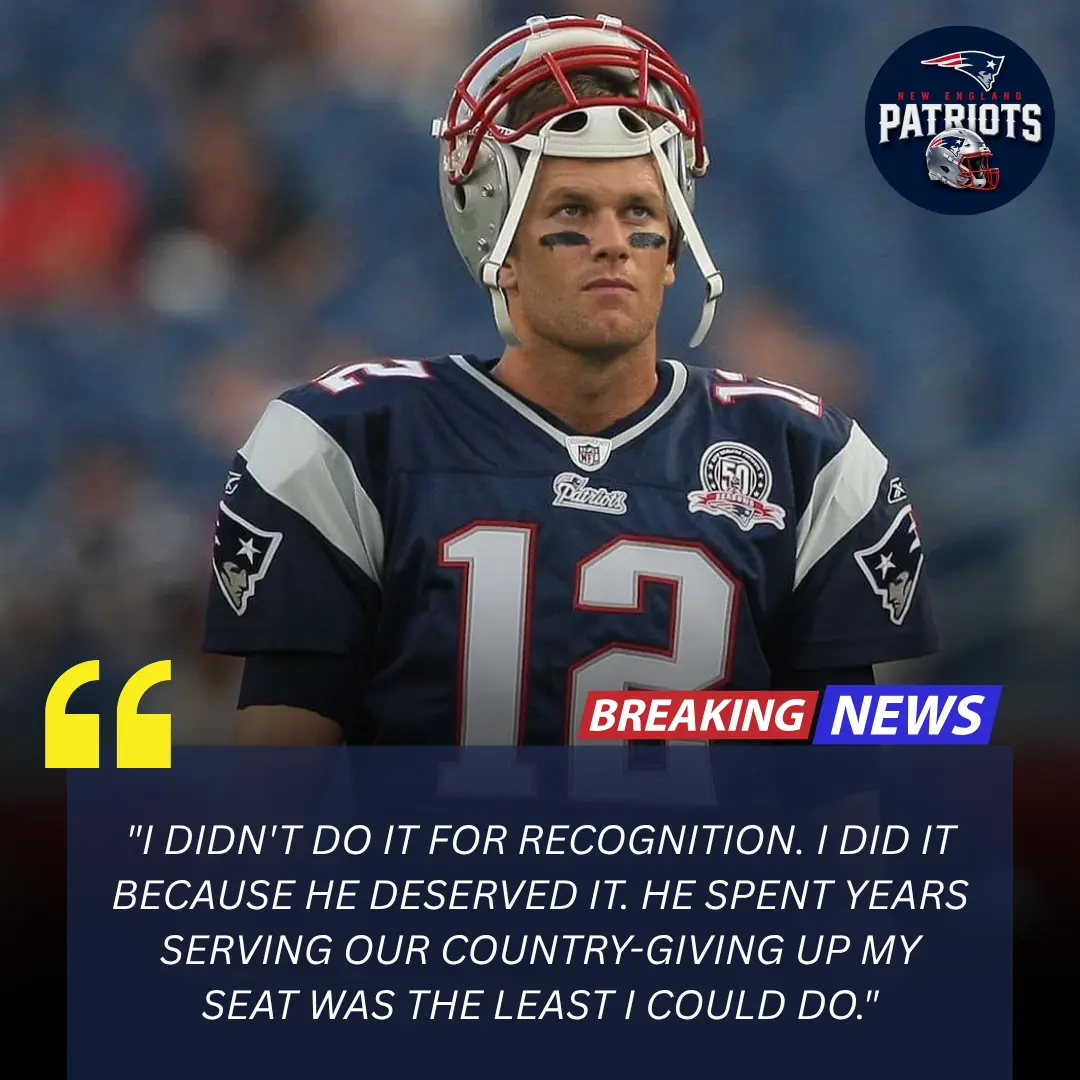
DISCLAIMER: This article discusses a circulating narrative claiming that Tom Brady voluntarily gave up a premium airline seat to an elderly military veteran shortly before a flight departed. This article does not independently confirm that the seat exchange occurred exactly as described, nor does it identify the veteran, airline, flight, date, route or alleged witnesses without authenticated evidence. No conversation between Brady and the veteran has been invented. The three photographs above are real illustrative images related to Tom Brady and are not presented as photographs of the alleged flight or seat exchange. The incident should be treated as confirmed only if supported by an identifiable firsthand account, authenticated photographs/video, Brady or his representatives, the airline involved, or reliable reporting.