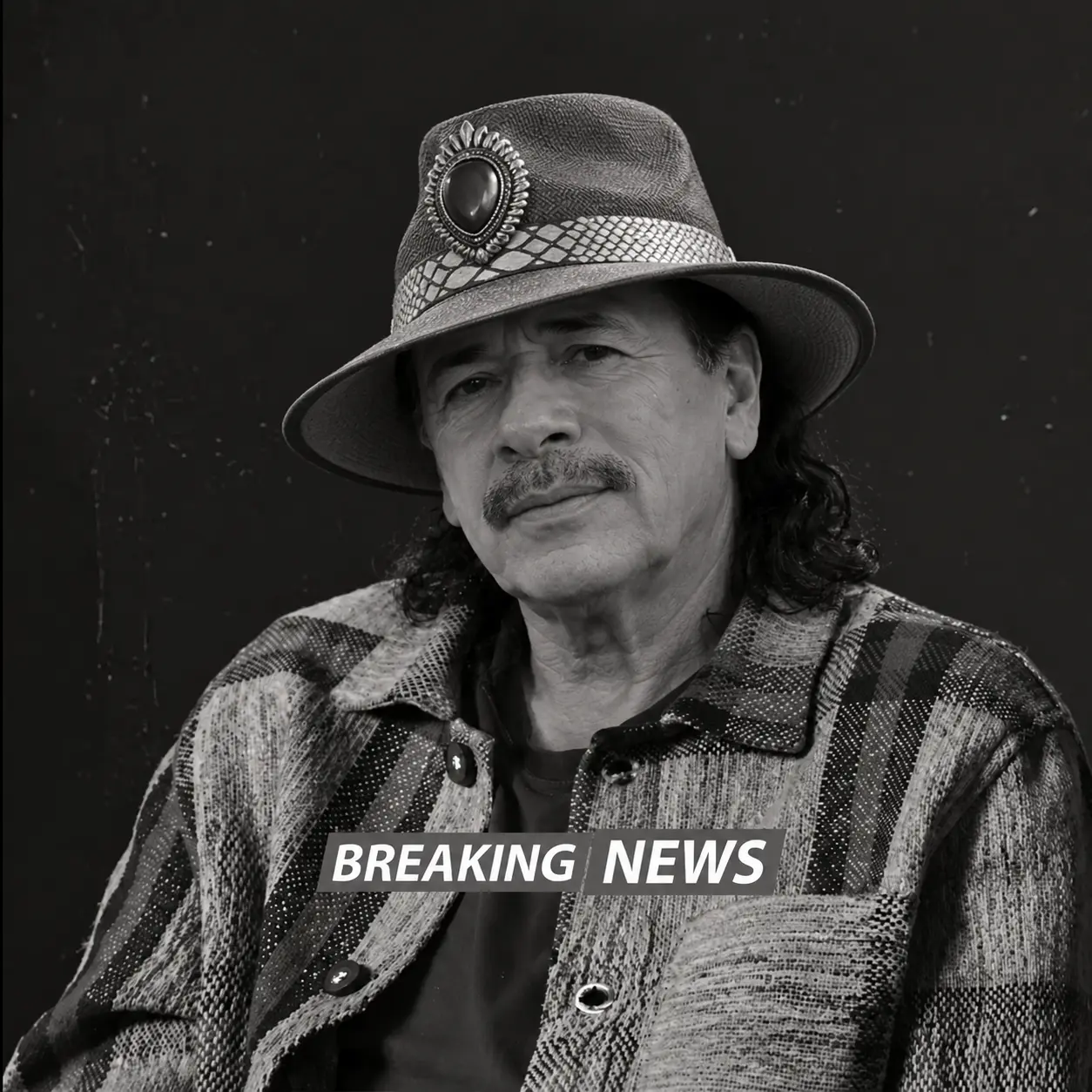
🚨💔 “PLEASE KEEP CARLOS AND HIS FAMILY IN YOUR THOUGHTS” — Emotional Update Surrounding Carlos Santana Touches Fans Worldwide as Decades of Music, Family and Unforgettable Memories Come Rushing Back 🎸💙🙏
For more than half a century, Carlos Santana has communicated with millions of people without needing to say a single word.
One guitar note could do it.
A sustained melody.
A sudden burst of fire from the fretboard.
A sound so distinctive that listeners could recognize the musician almost immediately.
Now, however, it is not a guitar solo generating an emotional response from longtime supporters.
A deeply personal update involving Santana and his family has sparked an outpouring of warm wishes, reflection and concern from fans who have followed the legendary guitarist across generations.
The original announcement has been described only in broad emotional terms, without identifying a specific illness, tragedy or emergency.
That distinction matters.
Without additional confirmed details, speculation should not be presented as fact.
But the enormous emotional response surrounding Santana illustrates something that numbers, awards and record sales cannot fully explain.
For millions of listeners, Carlos Santana stopped being simply a musician a long time ago.
His music became part of their lives.

To understand why an update involving Santana can generate such an immediate reaction, it is necessary to understand the extraordinary length of his connection with audiences.
His career reaches back to a dramatically different musical era.
Before streaming.
Before social media.
Before a song could reach millions of people within hours because of an algorithm.
Santana built his reputation through performance, musicianship and a sound that refused to remain inside one category.
Rock was there.
So was blues.
Latin percussion became central to the identity.
Jazz, spirituality and improvisation entered the conversation.
Then there was the guitar.
Santana did not need dozens of notes to announce his presence.
Sometimes one was enough.
That ability helped transform him from a young musician emerging from San Francisco's music scene into an internationally recognized figure.
Woodstock became one of the defining early chapters.
But it was never the final chapter.
That may be the most remarkable part of Santana's journey.
He continued.
Through changing decades.
Changing audiences.
Changing technology.
Changing definitions of what popular music was supposed to sound like.
He survived trends that arrived, dominated and disappeared.
Then, decades into his career, Supernatural introduced his music to another generation.
Suddenly younger listeners who had not witnessed his early years were hearing that guitar everywhere.
It was another reminder that certain musical identities cannot easily be confined to one era.

That longevity creates a relationship between artist and audience that is different from ordinary celebrity.
People grow up with the music.
A teenager hears Santana for the first time.
Years later, the same song plays during a road trip.
Then at a wedding.
Then inside a family home.
Eventually that teenager becomes a parent or grandparent.
The music remains.
That is why personal news involving an artist with Santana's history can feel surprisingly intimate.
Fans may never have met him.
But they remember where they were when they first heard his guitar.
Music creates those strange emotional bridges.
The artist does not know the listener's story.
The listener nevertheless attaches the artist's work to some of the most important moments of life.
Santana's public image has also long extended beyond technical musicianship.
He has frequently approached music as something spiritual.
Performance, in that philosophy, is not merely entertainment.
It is communication.
Healing.
Connection.
A way of expressing emotions that ordinary conversation sometimes cannot reach.
That philosophy helps explain why his audience often speaks about his music in unusually personal terms.
They are not simply discussing impressive guitar playing.
They are discussing how the music made them feel.
And feelings create loyalty.
The latest emotional attention surrounding Santana and his family therefore arrives with decades of memories attached.
Fans naturally want answers.
What happened?
What exactly was announced?
How is Carlos?
How is his family?
Those are understandable questions.
But concern can quickly become rumor when specific information is absent.
Social media accelerates that problem.
A vague phrase becomes a dramatic headline.
A dramatic headline becomes an assumption.
An assumption gets repeated until people begin treating it as established fact.
That is why restraint matters, particularly when stories involve someone's health, family or private life.
An emotional announcement does not automatically mean tragedy.
Warm wishes do not automatically confirm an emergency.
Tears do not establish what happened.
Until the underlying details are clearly known, the most respectful response is not to manufacture the missing pieces.
There is already enough to reflect upon without doing that.
Santana's career alone provides an extraordinary story.
A musician with roots spanning cultures helped reshape the sound of American rock.
He brought Latin rhythmic traditions into spaces where they had rarely received such mainstream visibility.
He showed that guitar music could be technically sophisticated while remaining emotionally immediate.
He collaborated across generations rather than retreating into nostalgia.
Most importantly, he remained unmistakably himself.
Musicians can copy techniques.
They can purchase similar equipment.
They can study the same scales.
But identity is much harder to reproduce.
Santana's greatest achievement may be that listeners can often recognize him before anyone says his name.
That kind of artistic fingerprint is rare.
Behind the musician, however, is a family.
And that is the part of the story that becomes increasingly important whenever personal updates emerge.
Fans see the stage.
Families see everything else.
They see exhaustion after the concert.
Travel.
Preparation.
Recovery.
Ordinary mornings.
Private conversations.
Difficult decisions.
Celebrations that never become public.
The famous person eventually comes home and becomes simply a husband, father, relative or friend.
Santana's wife, Cindy Blackman Santana, understands the musical world herself.
As an accomplished drummer, she knows the demands of performance from inside the profession rather than from the sidelines.
That shared understanding gives their partnership another dimension.
Two musicians.
Two careers.
One relationship shaped partly through the language they both understand best.
Music.
When fans send support toward Santana and his family, therefore, they are responding not merely to a celebrity headline.
They are responding to people whose lives have intersected with their own through sound.
That connection becomes especially visible during uncertain moments.
The awards matter less.
Chart positions matter less.
The size of the venue matters less.
People begin thinking about the human being.
They remember that every legendary musician eventually steps away from the microphone.
Every stadium empties.
Every tour ends for the night.
And beyond the lights exists an ordinary life containing the same fundamental things everyone values.
Family.
Health.
Time.
Love.
Presence.
Those realities can make even the most celebrated career feel suddenly fragile.
Perhaps that is why the current wave of emotion feels so powerful.
Santana's music has accompanied millions of people through their own difficult moments.
Now, when an emotional family update appears, those same listeners instinctively want to send some of that warmth back.
A message.
A prayer.
A memory.
A favorite song.
A simple wish that Carlos and the people closest to him are surrounded by strength and peace.
Nobody outside the family needs to invent tragedy to understand that feeling.
Sometimes the most meaningful response to uncertainty is simply gratitude.
Gratitude for the music already created.
For the concerts.
For the collaborations.
For the unforgettable guitar lines.
For the ability of one musician to connect people who may share almost nothing else.
Whatever additional details eventually emerge about the announcement, Santana's larger legacy is already secure.
His music crossed borders.
It crossed generations.
And it crossed the invisible distance between performer and listener.
That is why millions care.
Not because Carlos Santana is merely famous.
But because somewhere, during some moment in their lives, his guitar spoke to them.
And now, as attention turns toward Santana and his family, fans around the world are answering in the language they know best:
Love, gratitude and hope.
The entertainment community, as well as millions of fans around the world, is wiping away tears and sending their warmest wishes to Carlos Santana and his family following their latest emotional announcement... 🎸💙🙏